5 min read

Microsoft Fabric vs Snowflake vs Databricks for Mid-Market

Microsoft Fabric vs Snowflake vs Databricks for Mid-Market
10:32

Most platform comparisons are generic feature checklists that never ask how many people you have or how much data you actually run. This one is built for mid-market: 10–50 TB, one to three analytical teams, and no 50-person data org to throw at the problem. At that scale the question isn't which platform is most powerful, because all three can carry your workloads. The question is which one fits your team, your ecosystem, and your budget with the least rework. Below are three platforms, five decision criteria scored against mid-market constraints, and a rubric you can run in 30 minutes. It's the same rubric we run with clients at Compoze Labs.

The three platforms at a glance

Microsoft Fabric is a SaaS analytics platform that unifies data engineering, warehousing, and Power BI under one capacity-based license. It's built for teams that want to ingest data, process it, and put business metrics in front of leadership quickly, especially shops already standardized on Microsoft. See the Microsoft Fabric documentation for the full capability set.

Snowflake is a mature, cloud-neutral data platform with a consumption-based pricing model and first-class data sharing. It runs across AWS, Azure, and Google Cloud, and it handles mixed operational and analytical workloads from a consistent underlying data source. Its pricing options separate storage and compute so you pay for what you use.

Databricks is a lakehouse-native platform built on Apache Spark, Delta Lake, and MLflow. It's the strongest fit for capable engineering teams running machine learning and advanced analytics, and it also supports a lakehouse architecture for cross-departmental analytics. The Databricks Data Lakehouse page covers the architecture in detail.

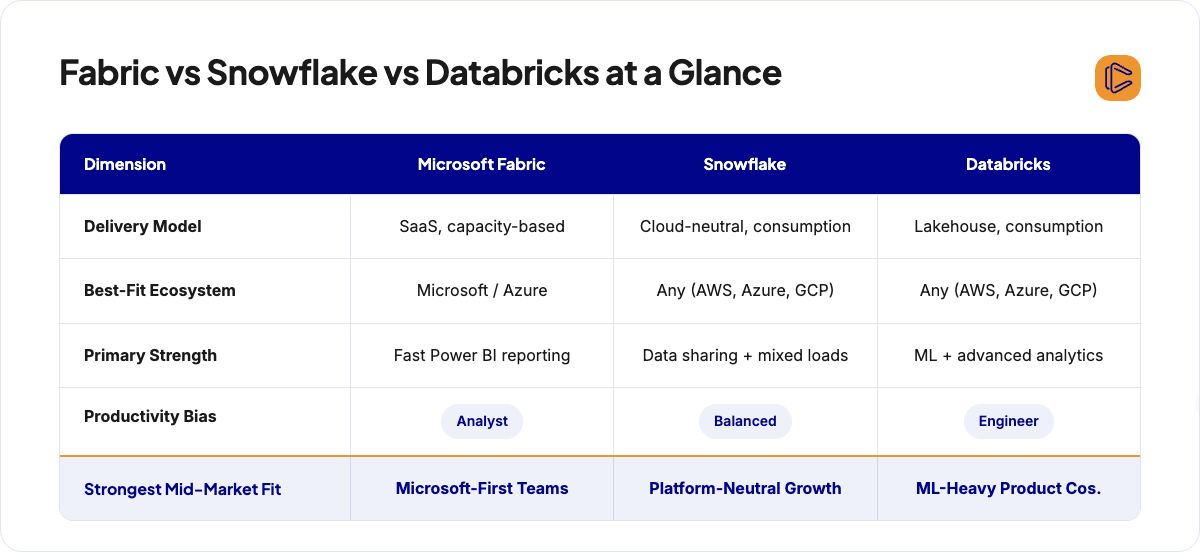
Here's how they compare on the dimensions that matter at mid-market scale:

Comparison table of Microsoft Fabric, Snowflake, and Databricks by delivery model, ecosystem, primary strength, and mid-market fit

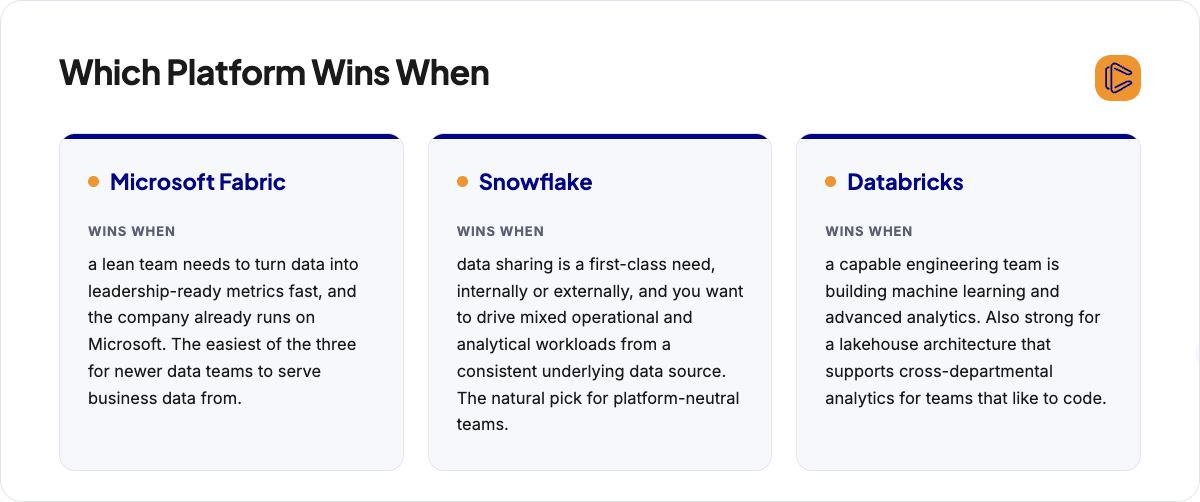
Fabric wins when…

Fabric wins when a smaller team needs to intake data, process it, and distribute business insights to leadership, especially when the company already runs on Microsoft. If your analysts live in Power BI and your stack is Azure and Microsoft 365, Fabric removes integration steps and gets metrics in front of decision-makers fast. Newer data teams without deep coding capability tend to find it the easiest of the three to serve business data from.

Snowflake wins when…

Snowflake wins when data sharing is a first-class need, internally or externally, and when you want to drive mixed workloads (operational and analytical) from a consistent underlying data source. It's also the natural pick for platform-neutral companies that don't want to commit to a single cloud and have established Python or R capabilities to put to work.

Databricks wins when…

Databricks wins when a capable engineering team wants to keep building machine learning and advanced analytical use cases. It's also a strong choice for a data lakehouse architecture that supports cross-departmental analytics. If your team includes engineers who love to code and your roadmap leans on ML, Databricks rewards that depth.

When Microsoft Fabric, Snowflake, and Databricks each win for a mid-market data team, summarized in three comparison cards

Five criteria that decide it for mid-market

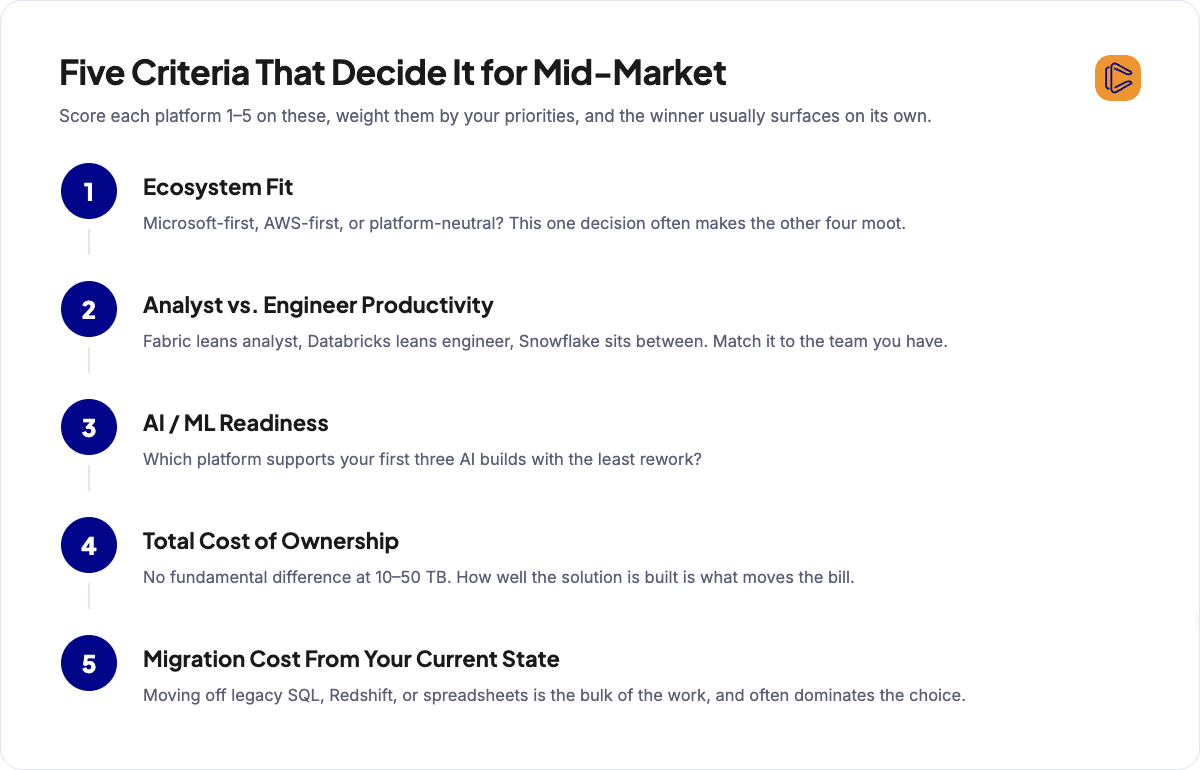
Start every evaluation with one question: what business outcomes do you expect? For mid-market companies without large data engineering teams, the outcome is usually the same. Business leaders need a clear view of key metrics. From there, your systems, your existing tool stack, and your team's skills decide the rest. These five criteria turn that into a scorable framework.

Five criteria for choosing a mid-market data platform: ecosystem fit, analyst vs engineer productivity, AI readiness, cost, and migration

1. Ecosystem fit

Are you Microsoft-first, AWS-first, or platform-neutral? This one decision often makes the other four moot. A Microsoft-first shop gets compounding value from Fabric's native integration with Azure and Power BI. A team that's deliberately multi-cloud or cloud-agnostic will lean toward Snowflake or Databricks, both of which run across AWS, Azure, and Google Cloud.

2. Analyst productivity vs. engineer productivity

Fabric biases toward analyst productivity, with low-code ingestion and Power BI reporting that a lean team can run without heavy engineering. Databricks biases toward engineer productivity, rewarding teams that write Python and Spark. Snowflake sits in between, comfortable for SQL analysts while supporting Python and R for teams that have those skills. Match the platform to the people you already have, not the team you wish you had.

3. AI / ML readiness

Ask which platform will support your first three AI builds with the least rework. If those builds are dashboards, anomaly alerts, and a forecasting model fed by clean business data, any of the three can get you there. If they're custom models, feature engineering, and production ML pipelines, Databricks gives engineering teams the most headroom. Whichever you pick, the readiness of the underlying data tends to decide how much rework those first builds take.

4. Total cost of ownership at mid-market scale

There's no fundamental TCO difference between the three at 10–50 TB. All three scale alongside your business when the solution is built well, and all three can run up disproportionate cost when it isn't. What moves your bill is whether the data is engineered properly for the use case and whether the workloads are designed to match the value they produce. In the engagements we run, unrealized value almost always traces back to misaligned expectations or data that wasn't engineered for the use case, rather than to the platform brand.

5. Migration cost from your current state

Migration cost often dominates platform selection for mid-market, and it's where most of the work lives. Moving from on-prem SQL Server, Redshift, or an older warehouse, or from paper and spreadsheet processes, into any of these platforms is a meaningful project. The platform you land on matters far less than how the migration is implemented, and the trade-off between modernizing in place and starting over usually shapes the timeline more than the platform choice does.

A decision rubric you can run in 30 minutes

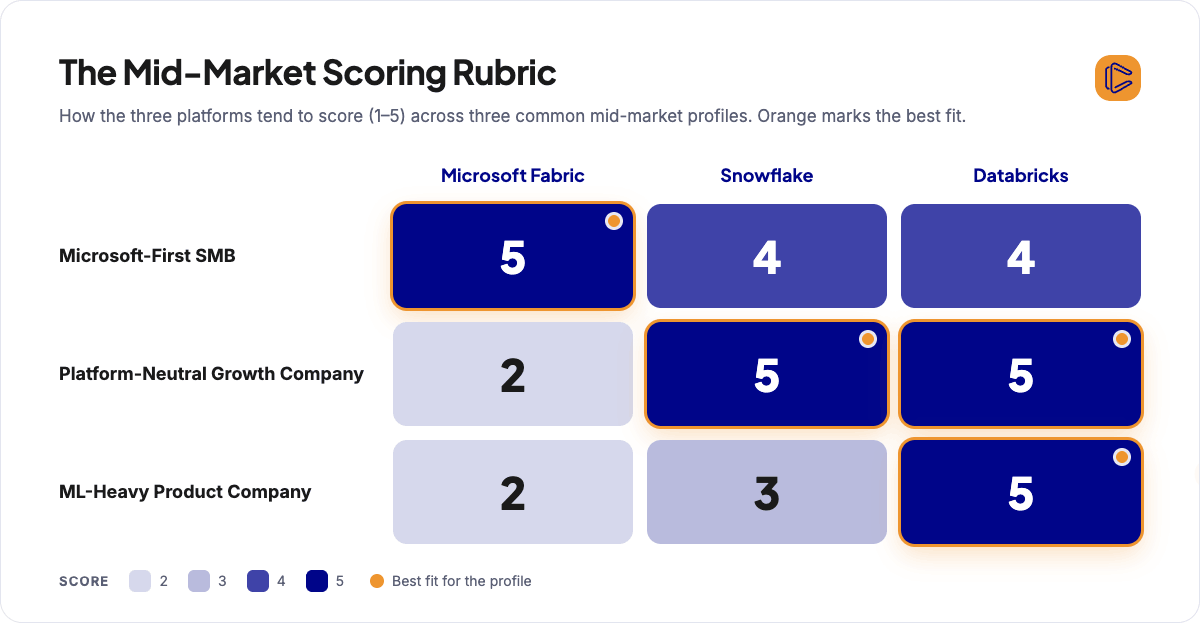
Score each platform 1–5 against your team's profile across the five criteria, weight the criteria by your business priority, and the winner usually surfaces on its own. To anchor the exercise, here's how the three platforms tend to score across three common mid-market profiles:

Scoring grid rating Microsoft Fabric, Snowflake, and Databricks 1 to 5 across three mid-market profiles, best fit marked in orange

A few reads on the numbers. The Microsoft-first SMB can succeed on any of the three, but Fabric's native fit makes it the path of least resistance. The platform-neutral growth company gets the most from Snowflake or Databricks because neither locks it into a single cloud, and Fabric's value drops sharply outside the Microsoft estate. The ML-heavy product company sees Databricks pull ahead because engineering depth and ML tooling are exactly what it's built for.

To run your own version: list the five criteria down a page, assign each a weight from 1–3 based on what your business cares about most, score each platform 1–5, multiply, and total the columns. Thirty minutes of honest scoring beats three months of debate.

How Compoze Labs helps you choose and build

Choosing here is a bit like choosing between a Lexus, a Cadillac, and a Lincoln. Most use cases are supported natively by all three, so the decision is rarely about raw capability. The mistake we see most often is picking a platform that doesn't match the team's skills. Fabric can be the wrong call for a team of strong Python engineers who want to keep coding, just as a low-code team can stall on Databricks.

Platform choice carries three-year consequences, and the value you get from any of them comes down to implementation. We've built on all three, so we can pressure-test your scoring, bring lessons from similar migrations, and keep you clear of the misaligned expectations that leave value unrealized. Most of what gets called an AI-readiness problem is an old data problem that a new platform just makes visible.

That's the work our data engineering team does: modernize the core off legacy systems, connect the ecosystem so data moves between systems without losing meaning, and architect the layer your analytics, applications, and AI run on. Senior engineers and architects embed with your team in agile cycles, tie every milestone to an outcome you can defend to leadership, and hand off a system your team owns. See how we approach it on our data engineering services page.

For proof that outcomes track implementation more than the platform logo: we rebuilt Budscout's proof-of-concept into a production platform with real-time ingestion of ultra-HD imagery and spectral data, analytics layered on custom-trained models, and a continuous learning loop. Their autonomous scouting robots now detect plant stress up to ten days earlier than the human eye. Read the Budscout case study.

For independent market context as you evaluate, Gartner's Cloud Database Management Systems reviews and the Forrester Wave: Cloud Data Warehouses both cover these vendors against detailed criteria.

5 Digital Transformation Mistakes to Avoid and What to Do Instead

5 Digital Transformation Mistakes to Avoid and What to Do Instead

Ready to transform your business digitally? A Digital Transformation is about reinventing your business from the core, reimagining every process from...

Read More
How to Build an Azure Landing Zone for Regulated Industries

How to Build an Azure Landing Zone for Regulated Industries

Most Azure landing zone projects for regulated companies are scoped backwards. The plan reads infrastructure first: design the platform, build it...

Read More
How Composable ERP Systems Modernize Legacy Operations Without Full Replacement

How Composable ERP Systems Modernize Legacy Operations Without Full Replacement

Your ERP system was perfect five years ago. Now it feels like trying to run a modern business with a flip phone. Adding new features takes forever....

Read More