.png?width=380&height=58&name=Layer_1%20(3).png "Compoze Labs Logo")


 Eric Carr
Five Shifts to Get AI Agents Right
 Eric Carr : Apr 14, 2026, 2:02:00 PM
In our previous blog on the AI agent transition, we looked at where this shift stands, the debate it's generating, and why the historical pattern...

Two years ago, most teams were using AI to speed up tasks they already knew how to do. Autocompleting code. Drafting emails. Summarizing documents. It delivered productivity gains. A four-hour analysis done in forty minutes felt like a breakthrough. But looking back, that was a warm-up for a much bigger shift.
In 2026, AI in the enterprise is changing form. We're moving from AI as a tool that helps individual workers to AI agents that execute entire workflows on their own, and from there, to coordinated fleets of agents running whole business functions.
The opportunity is enormous, and so is the organizational challenge. Every major technology wave, from electrification to the internet, created more economic value and more types of work than it displaced. But the gains were never automatic, and they were never evenly distributed. The companies and regions that adapted fastest captured disproportionate upside.
Software development is roughly two years ahead of other knowledge functions here. Today, the most advanced teams write structured specifications and let autonomous coding agents handle implementation, testing, and debugging. Humans define the intent, the system delivers verified outcomes.
This same arc is unfolding in every knowledge function: finance, legal, marketing, operations, HR. At Level 1, AI assists with discrete tasks. At Level 2, it becomes a sustained collaborator across workflows. At Level 3, workers manage teams of specialized agents. At Level 4, they manage interconnected fleets running entire business functions. At Level 5, still theoretical, organizations operate as AI-native entities where humans define purpose and constraints while AI handles execution.
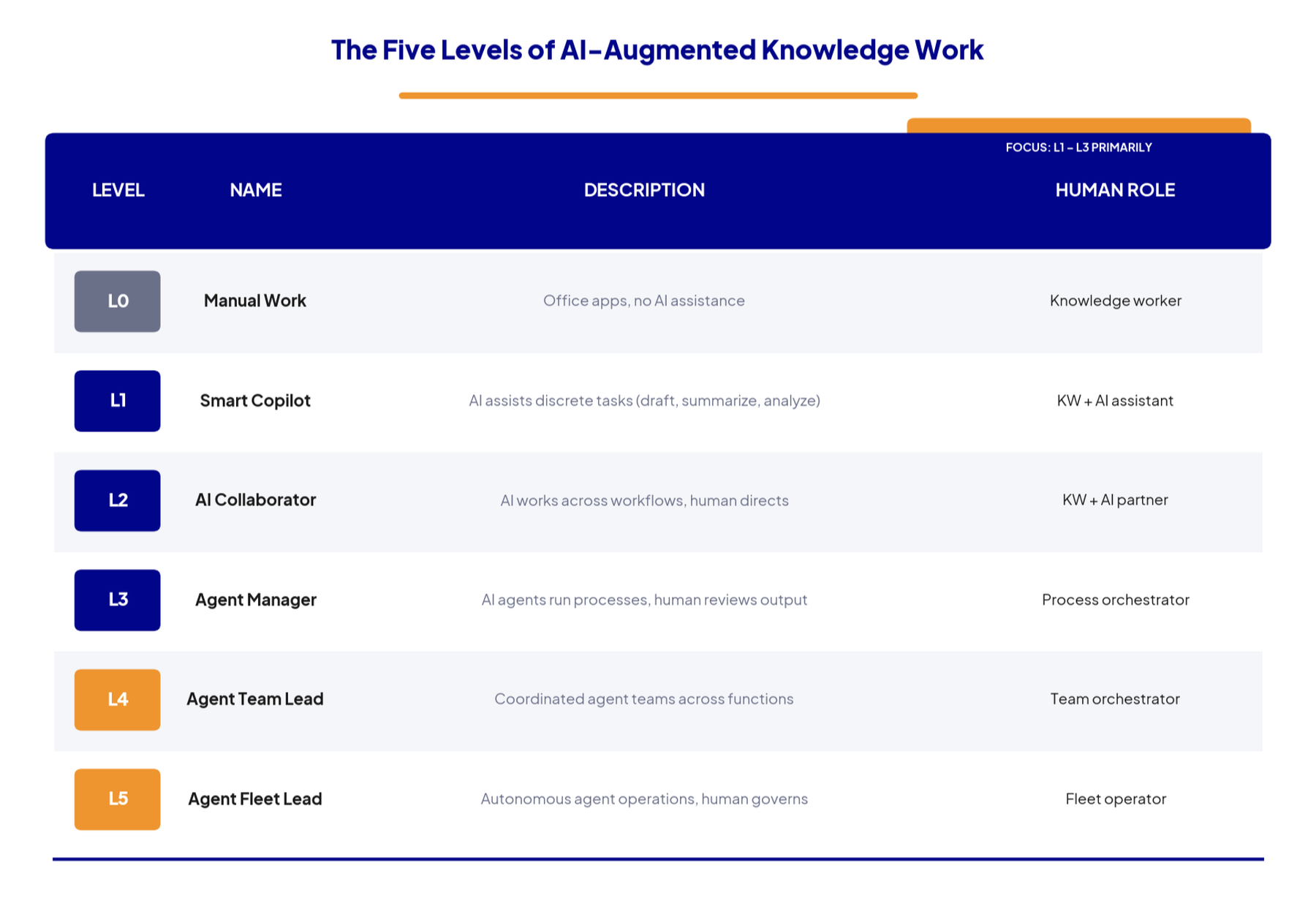
Most organizations sit between Level 1 and Level 2. The distance between that reality and where value creation is heading grows wider each quarter.
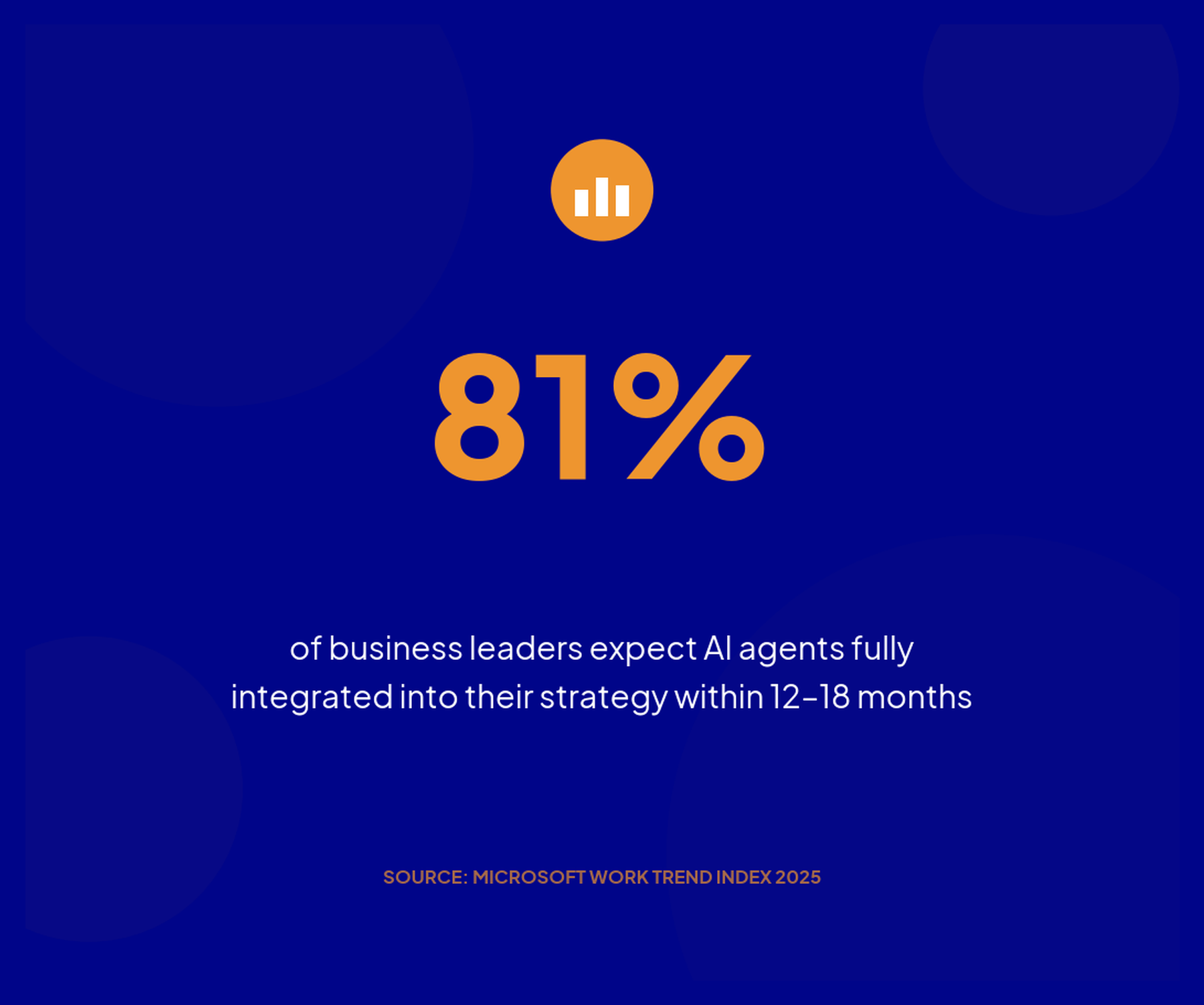
Every major research firm is landing on a version of the same story. Microsoft WorkLab reports that 81% of leaders expect AI agents to be integrated into their strategy within the next 12–18 months. Deloitte's workforce data shows AI tool access jumped from under 40% to around 60% in a single year. McKinsey estimates the economic opportunity at $2.6–4.4 trillion annually in added global GDP, but only about 1% of organizations report true AI maturity.
That 1% number is the one worth sitting with. Enormous opportunity, almost nobody capturing it yet.
That disconnect has fueled a fierce public debate. Citrini Research's "2028 Global Intelligence Crisis" went viral in February 2026 with a scenario in which AI displaces white-collar workers so quickly that consumer spending collapses. A provocative thought experiment that triggered what Barron's dubbed the "Citrini selloff." Citadel Securities responded by pointing to labor market data showing software engineering job postings up 11% year-over-year, and to the historical pattern that major technology shifts have consistently been growth-enhancing, not employment-destroying, at the macro level.
Both sides are capturing something. The question is which part of the pattern you weight more heavily.
The Citrini scenario assumes institutions are inert. That firms will substitute labor with AI at speed, that displaced wages vanish, and that no countervailing mechanism emerges. That's the weakest link in an otherwise well-constructed thought experiment. Institutions adapt. They always have, though not always gracefully and not always in time.
The stronger signal is what's already happening on the ground. AI coding tools have dramatically reduced the cost of building software, giving rise to what technologists call the "hypertail." An explosion of targeted, customized applications that simply weren't economical to build before. Teams are spinning up custom agents, automated workflows, and AI-driven decision pathways tailored to problems that were never worth a six-figure software project.
This is how technology waves have always created new value: by making entirely new categories of work economical for the first time.
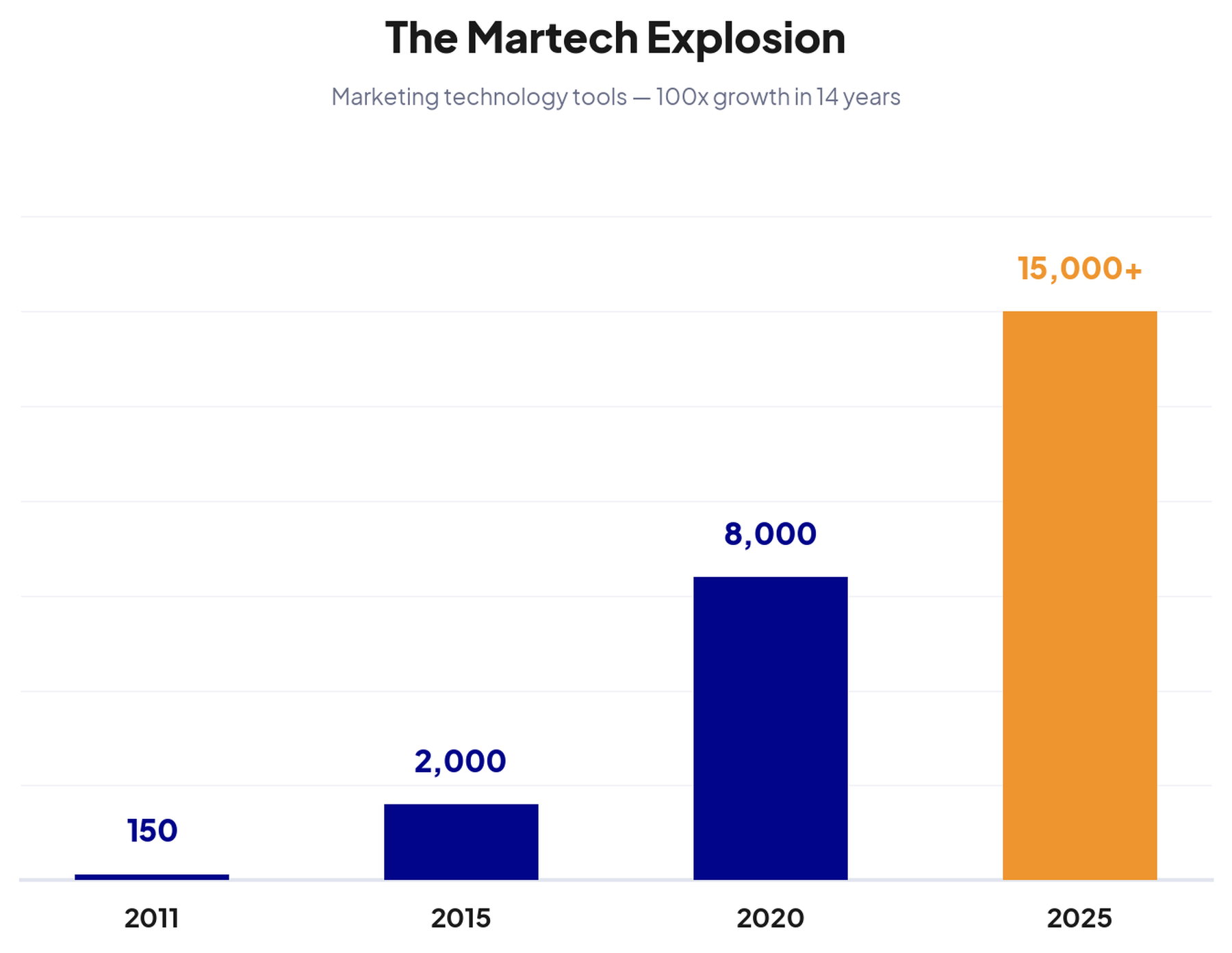
The martech landscape went from 150 tools in 2011 to over 15,000 by 2025. AI agents are extending that curve into millions of purpose-built micro-applications. The people building them increasingly aren't developers. They're knowledge workers who can now direct AI to solve problems that never had a software budget. That's an expansion of who gets to create, and what gets built.
But the benefits won't land uniformly. Specific industries and geographies will feel sharply different impacts, and the 89% of organizations still running what McKinsey calls "industrial-age structures" risk being on the wrong side of that divide.
Researchers modeling this transition have identified four plausible futures, shaped by how fast AI capabilities advance and how well governance keeps pace.
In a Productivity Boom, both move quickly. Agent teams become standard operating procedure, cycle times collapse, new markets open as software costs plummet, and frontier firms gain significant operating leverage. History suggests this is the most likely macro outcome. Every prior general-purpose technology from electricity to the internet followed this path, though the transition was never painless and the gains were never instant.
In Automation Shock, capabilities outrun governance. Incident rates climb, public backlash triggers deployment freezes, and labor disruption hits specific sectors hard before organizations adapt.
In Gradual Integration, strong governance moderates the pace but produces durable deployments, higher institutional trust, and a steadier workforce transition.
And in a Stalled Potential, capability progress stalls or costs stay too high. Most value remains locked in copilots and assistants, with full agent autonomy limited to narrow domains.
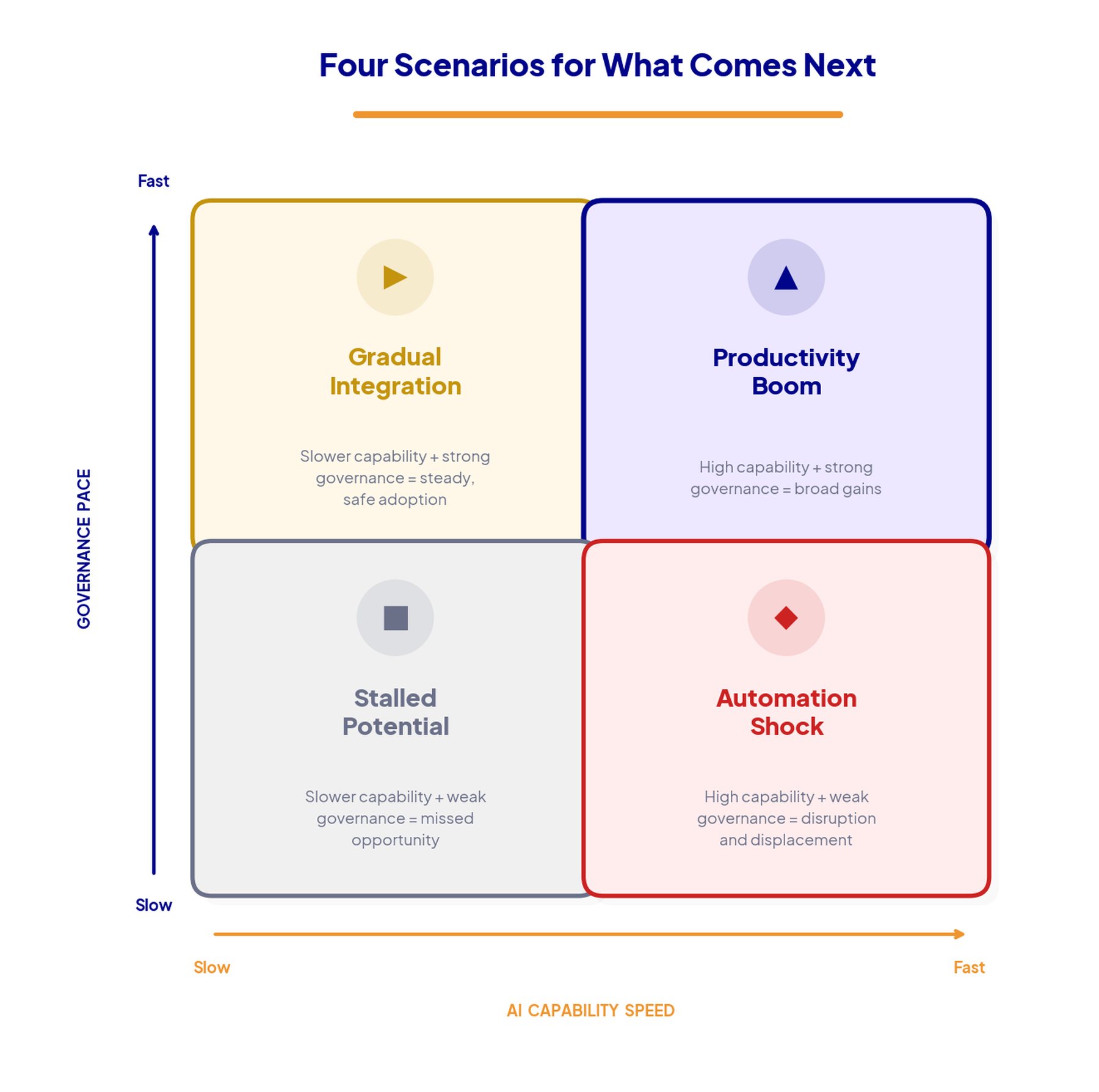
None of these futures includes "nothing changes." The variable is which scenario your organization ends up in, and how much of that outcome you can influence.


Eric Carr : Apr 14, 2026, 2:02:00 PM
In our previous blog on the AI agent transition, we looked at where this shift stands, the debate it's generating, and why the historical pattern...

Eric Carr : May 7, 2026, 4:01:03 PM
You've been asked to fund AI. You don't have a CTO. And every research report you've opened so far is written for people who already know the...

Eric Carr : Jul 22, 2026, 10:48:32 AM
Count your active AI pilots. In the organizations we walk into, the number is usually somewhere between 15 and 30. Now name one workflow that runs...