3 min read

Where to Start with AI in 2026

Where to Start with AI in 2026
5:19

TL;DR

  • You're not behind. 88% of organizations are using AI, but only 7% have achieved full enterprise scale. Most are still experimenting.
  • Start with outcomes, not tools. Define 2-3 measurable business results before evaluating any technology.
  • Know your data. Audit what you have, where it lives, and what shape it's in.
  • Think workflow redesign, not bolt-on. Adding AI to broken processes just makes them faster and broken.
  • Leadership can't disappear after kickoff. Organizations seeing results from AI are 3x more likely to have senior leaders actively engaged over time.

If you're heading into 2026 without a clear AI strategy, here's something that might surprise you: most organizations don't have one either.

McKinsey's latest research shows that while 88% of organizations are using AI in some capacity, nearly two-thirds are still in the experimenting or piloting phase. Only 7% have achieved what researchers call "full scale" AI that's truly embedded across their enterprise. The gap between "using AI" and "seeing measurable impact" is where most organizations are stuck.

That's actually good news if you're just getting started. The race isn't over—for most organizations, it's barely begun.

Start with the Business Problem, Not the Technology

It's tempting to begin with "what AI tools should we buy?" But that's putting the cart before the horse. The smarter starting point is different: What specific business outcomes would move the needle for us?

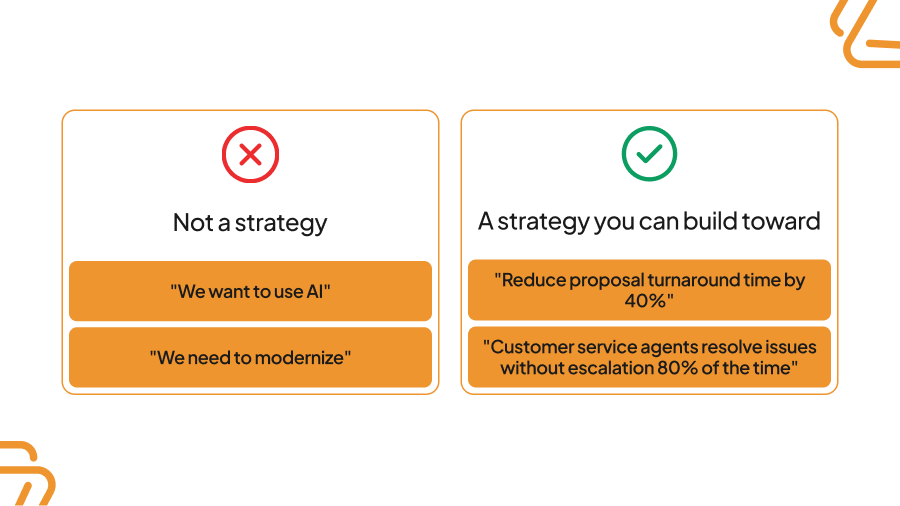
This isn't about being anti-technology. It's about being precise:

Comparison chart showing vague AI goals like 'We want to use AI' versus measurable business outcomes like 'Reduce proposal turnaround time by 40%' for effective AI strategy planning

Before you talk to any vendors or spin up any pilots, get your leadership team aligned on two or three specific outcomes that matter. Write them down. Make them measurable. Everything else flows from there.

Understand What You're Actually Working With

AI runs on data. Before you can do anything meaningful, you need an honest assessment of what data you have, where it lives, and what shape it's in.

This doesn't have to be a massive data governance initiative. Start with four questions:

  1. Where does the data live that's relevant to your priority use cases?
  2. How clean and complete is it?
  3. Who has access, and are there any obvious permission issues?
  4. Are there documented processes for how this data gets created and maintained?

Many organizations are surprised to discover they have more AI-relevant data than they thought. It's just scattered across systems or inconsistently maintained. Knowing this upfront saves a lot of frustration later.

Think Workflows, Not Point Solutions

Here's where a lot of early AI efforts go sideways: they bolt AI onto existing processes and expect transformation. Add a chatbot here, automate a form there. The result is usually incremental improvement at best, and often just added complexity.

A better approach looks different. Start by identifying workflows that are:

  • High-volume — enough activity to justify the investment
  • Data-rich — information AI can actually work with
  • Tied to outcomes you care about — connected to the metrics that matter

Then ask how those workflows might be fundamentally redesigned with AI capabilities in mind.

This doesn't mean redesigning everything at once. Pick one workflow to start. But think about it end-to-end, not just "where can we add AI to what we're already doing?"

Get Leadership Involved and Keep Them There

AI initiatives often start with executive enthusiasm and budget approval, then get handed off to IT or an innovation team to figure out. But the data is clear: sustained success requires ongoing leadership involvement.

Key finding: McKinsey's research found that organizations seeing results from AI are nearly 3x more likely to have senior leaders who demonstrate strong ownership and commitment to AI initiatives—not just at launch, but over time.

Before you launch anything, make sure you have executive sponsors who understand this isn't a "set it and forget it" initiative. The most successful AI programs have leadership check-ins built into the process, not just milestone reviews.

What About Tool Selection?

Notice we haven't talked about specific AI tools yet. That's intentional.

Tool selection is step five, not step one. Once you have clarity on outcomes, understand your data landscape, identify the right workflows, and have leadership alignment, then you're ready to evaluate which tools fit your specific situation.

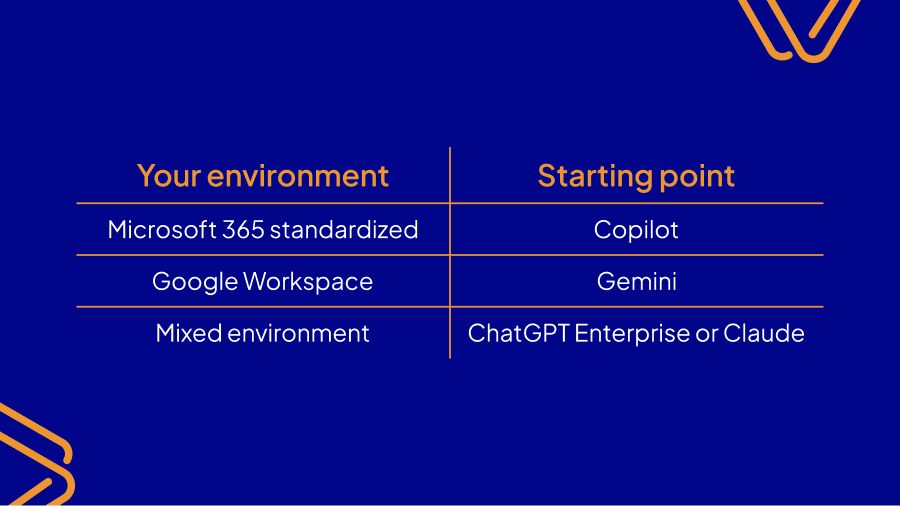
When you do get there, the decision is often simpler than expected:

AI tool selection guide showing recommended starting points: Copilot for Microsoft 365, Gemini for Google Workspace, and ChatGPT Enterprise or Claude for mixed environments

The "right" tool depends heavily on what you're already using and what you're trying to accomplish. But none of that matters if you haven't done the foundation work first.

Your First Move

If you're reading this thinking "we should have started sooner," stop. That thinking leads to rushing into tool purchases and scattered pilots. Exactly what creates problems for organizations further down the road.

You have something valuable: a clean slate. No legacy pilots to unwind. No sunk costs in tools that didn't pan out. No organizational habits built around approaches that aren't working.

Use that advantage. Build the foundation right from the beginning.

Your first move isn't choosing a tool or launching a pilot. It's getting your leadership team in a room for two hours to answer one question:

What three business outcomes would make AI worth it for us—and how would we measure them?

Write them down. Make them specific. Get genuine alignment, not head-nodding.

That's it. That's your starting point. Everything else—data assessment, workflow selection, tool evaluation, pilot design—flows from the answer to that question.

Start there.

Concepts to Consider While Building a RAG Chatbot

Concepts to Consider While Building a RAG Chatbot

Theworld is still only at day one of the Artificial Intelligence (AI) era, yet AI adoption has been much faster compared to the adoption of other...

Read More
The Four Waves of Enterprise AI Adoption

The Four Waves of Enterprise AI Adoption

If your enterprise AI journey has felt more like a maze than a roadmap, you’re not alone.

Read More
How to Build Process Automation That Actually Works

How to Build Process Automation That Actually Works

There’s a lot of pressure these days for businesses to automate their manual processes. Talk to any mid-level manager or director, and you’ll find...

Read More