Where to Start with AI in 2026
TL;DR You're not behind. 88% of organizations are using AI, but only 7% have achieved full enterprise scale. Most are still experimenting. Start...
You've made real investments in AI. Chatbots, automation, pilots that showed promise. But when the board asks about ROI, the conversation gets uncomfortable. The experiments were interesting. The results? Less clear.
If this sounds familiar, you're in good company—but not the company you want to be in.
McKinsey's latest research (November 2025) puts a fine point on the problem: while 88% of organizations are using AI, only 39% report any measurable impact on their bottom line. And the bar for "high performance" is stark—just 6% of respondents say their organizations are seeing more than 5% of EBIT from AI and report "significant value" from their investments.
Six percent. That leaves 94% investing time, money, and energy without clear returns.
So what's going wrong? It's usually not the technology.
When we work with organizations stuck in experimentation mode, the root cause is rarely the technology itself. It's usually one of three things.
Most companies approach AI primarily as an efficiency play: reduce costs, automate manual work, do more with less. Those are legitimate objectives, but they're not enough.
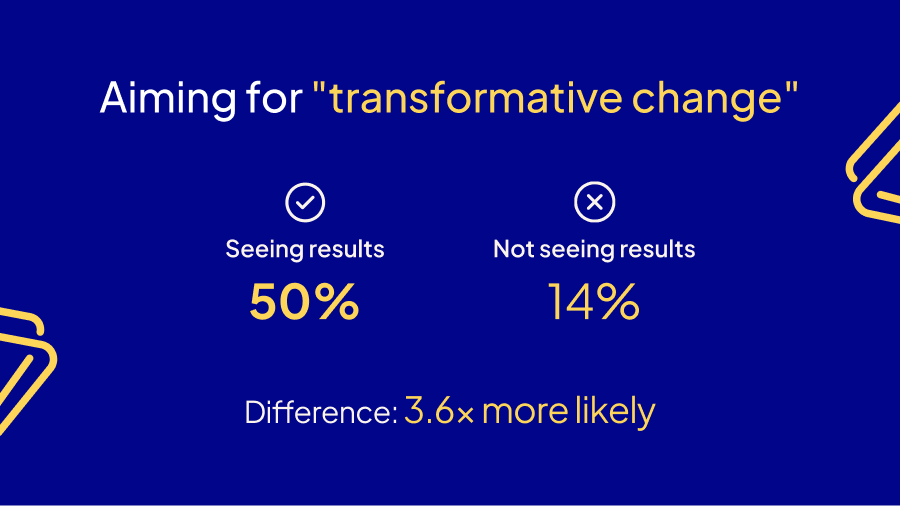
The data here is striking:

And it's not just ambition—it's what they're ambitious about:

Organizations seeing results pursue efficiency, growth, AND innovation. Those that aren't mostly just pursue efficiency.
The instinct is understandable. Take what you're already doing and make it faster or cheaper with AI. But this approach has a ceiling. You end up with incremental improvements at best, and often just added complexity.
Key finding: Organizations seeing results are 2.8x more likely to have fundamentally redesigned their workflows—55% versus just 20% of those that aren't.
Workflow redesign isn't just correlated with success—it's one of the strongest predictors of it. The difference isn't adding AI to existing processes. It's rethinking how work gets done from the ground up.
AI initiatives often start with executive enthusiasm and budget approval, then get handed off to IT or innovation teams to figure out. But sustained success requires ongoing leadership involvement—not just funding, but active championing, role modeling, and strategic guidance.
Organizations seeing results are 3x more likely to strongly agree that senior leaders demonstrate ownership of and commitment to AI initiatives.
These aren't passive sponsors—they're actively engaged in driving adoption, including using AI themselves.
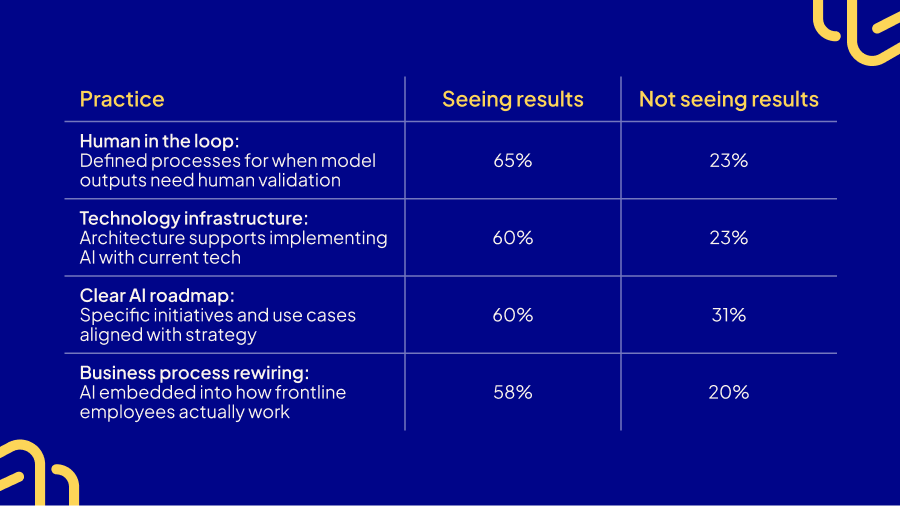
Beyond ambition and leadership, specific practices show up consistently in organizations seeing measurable impact. The research identified several that matter most:

Investment levels also diverge: Organizations seeing results commit more than 20% of their digital budgets to AI at 3x the rate of those that aren't (roughly one-third vs. 7%).
That investment correlates with scaling: about three-quarters of organizations seeing results have scaled or are scaling AI, compared with roughly one-third of those that aren't.
If your AI initiatives have stalled, the path forward usually isn't "try harder at what you've been doing." It's stepping back to address the underlying issues.
Five moves to make:
Here's the counterintuitive finding from the research: organizations seeing the most value from AI actually report more negative consequences—issues with inaccuracy, IP concerns, regulatory compliance. That's not because they're doing it wrong. It's because they're using AI for consequential work with real stakes. They're also actively mitigating those risks.
But that finding points to something uncomfortable for organizations that have stalled: if you've been investing in AI for two years and can't point to clear business impact, more investment probably isn't the answer.
The question you need to ask isn't "how do we accelerate?" It's "should we keep going in this direction at all?"
That's not defeatism. It's honesty. Sometimes the right move is to stop, acknowledge that the current approach isn't working, and start over with fundamentally different assumptions:
Abandoning an approach that isn't working isn't failure. Continuing to invest in it is.
If you're stalled, the path forward probably isn't doing more of what you've been doing. It's having the harder conversation about whether to change direction entirely.
TL;DR You're not behind. 88% of organizations are using AI, but only 7% have achieved full enterprise scale. Most are still experimenting. Start...
Theworld is still only at day one of the Artificial Intelligence (AI) era, yet AI adoption has been much faster compared to the adoption of other...
Generative AI is already a transformative force in today’s business landscape, and it’s only getting started.