.png?width=380&height=58&name=Layer_1%20(3).png "Compoze Labs Logo")


 Eric Carr
How to Rescue a Stalled AI Pilot
 Eric Carr : May 28, 2026, 4:06:13 PM
You funded an AI pilot. Your team shipped a proof-of-concept. Six months later, it still isn't in production — and the budget conversation for next...

Count your active AI pilots. In the organizations we walk into, the number is usually somewhere between 15 and 30. Now name one workflow that runs differently because of them. That second question is the one that stalls the room: the CIO can list six models under trial and zero processes that have changed.
MIT's 2025 NANDA study puts a number on it: 95% of enterprise generative AI pilots deliver no measurable return. The instinct is to blame the model. Wrong vendor, wrong LLM, immature tech. But you can't tune your way out of this one, because the difference between the 95% and the 5% shows up before a model is ever selected. Companies that stall start with a tool and go hunting for a use case. The ones that scale start with a workflow, a repeating sequence of decisions where a human exercises judgment, and ask where that judgment, data, risk, and measurement live.
Quick answer: most AI pilots fail because the organization added AI to an existing process instead of redesigning the workflow around it. The missing owner, the unready data, the late governance, and the unmeasured ROI that kill pilots at the rollout gate are symptoms of that one decision.
Here's the root cause, and the six symptoms it creates.
MIT's researchers traced the 95% failure rate to integration, not model quality. Generic AI tools stall inside enterprises because they don't learn from or adapt to the workflows around them. We see the same thing inside our own engagements: pilot portfolios in the double digits, zero workflows that run differently.
When a pilot stalls, one question cuts through the team's existing story about why:
What repeating decision is this pilot changing, and how will we know it changed?
If the room can't answer, the pilot was never attached to a workflow. It was attached to a demo. Drop AI into an existing process and you get a localized bump: a faster draft here, a quicker search there, zero structural change. The pilot "works" and nothing changes, because the thing around it was never touched.
The alternative is to treat the workflow as the unit of AI adoption. Map it. Find the judgment points and decide which an agent can take and which stay with a human. Then redesign the handoffs so the agent does the assembly and routing while the human moves to the edges, setting parameters up front and reviewing exceptions at the end. Start there and ownership, data, governance, and measurement all become answerable.
Skip that step and the failure shows up downstream wearing six different costumes. Here they are in the order a pilot usually meets them.
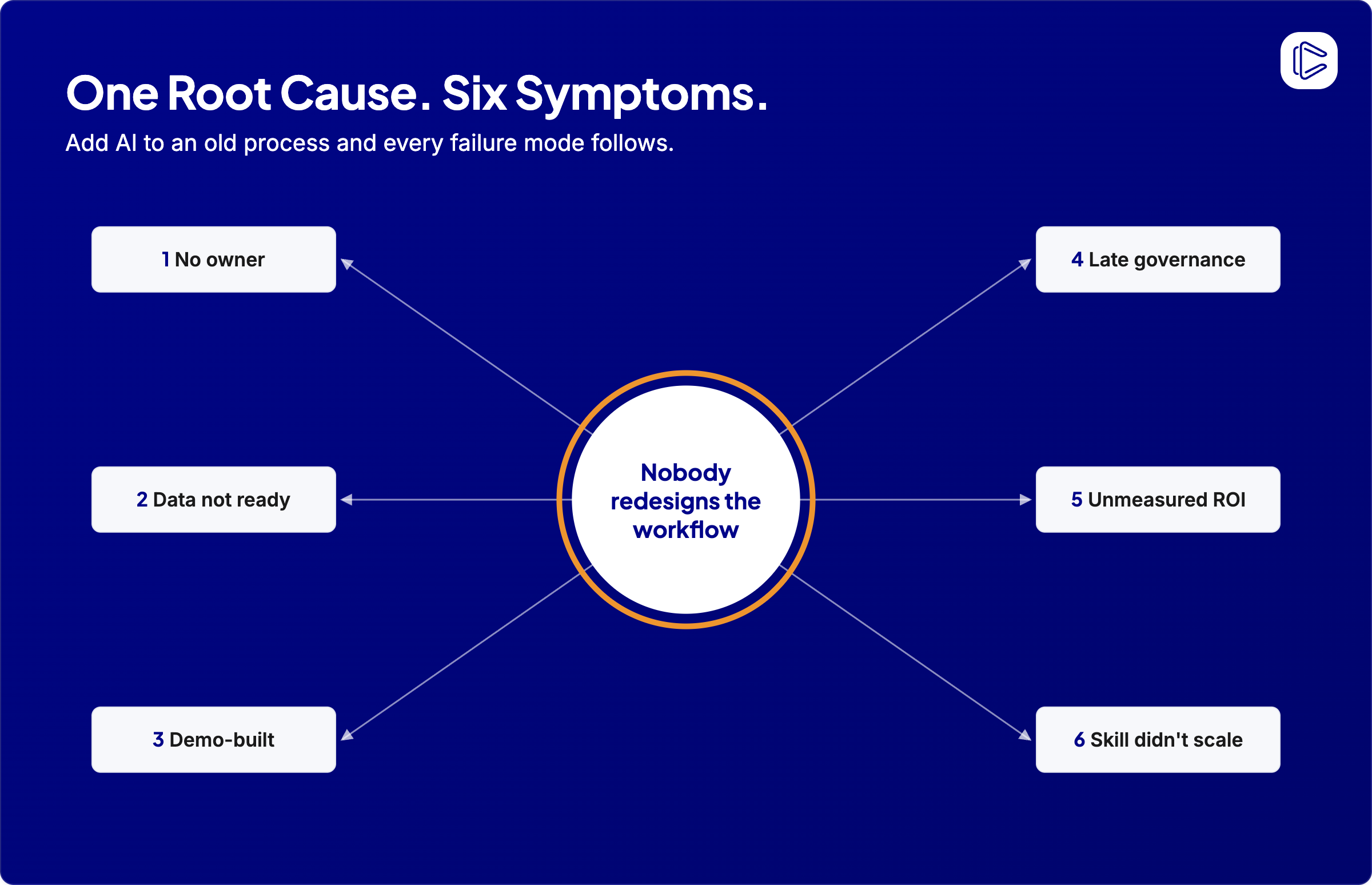
The six symptoms in 60 seconds:
The demo landed. Everyone clapped. Six weeks later the pilot is still "being evaluated," and the engineer who built it has rotated to the next experiment. Someone owned the experiment. No one owned the outcome.
Getting to production is a political act as much as a technical one. Somebody has to push the system into a team's live work, absorb the disruption that causes, and defend the line item at the next budget review. When the person accountable for the business result isn't the person running the model, or doesn't exist at all, none of that happens. Pilots get sponsored by curiosity and killed by ambiguity.
A redesigned workflow makes the owner obvious: whoever owns the process owns the pilot. Skip the redesign and ownership never lands anywhere.
The model is fine. The answers aren't. They come back generic, stale, or cut off from the system of record, and the team spends a month tuning prompts before anyone admits the model was never the problem.
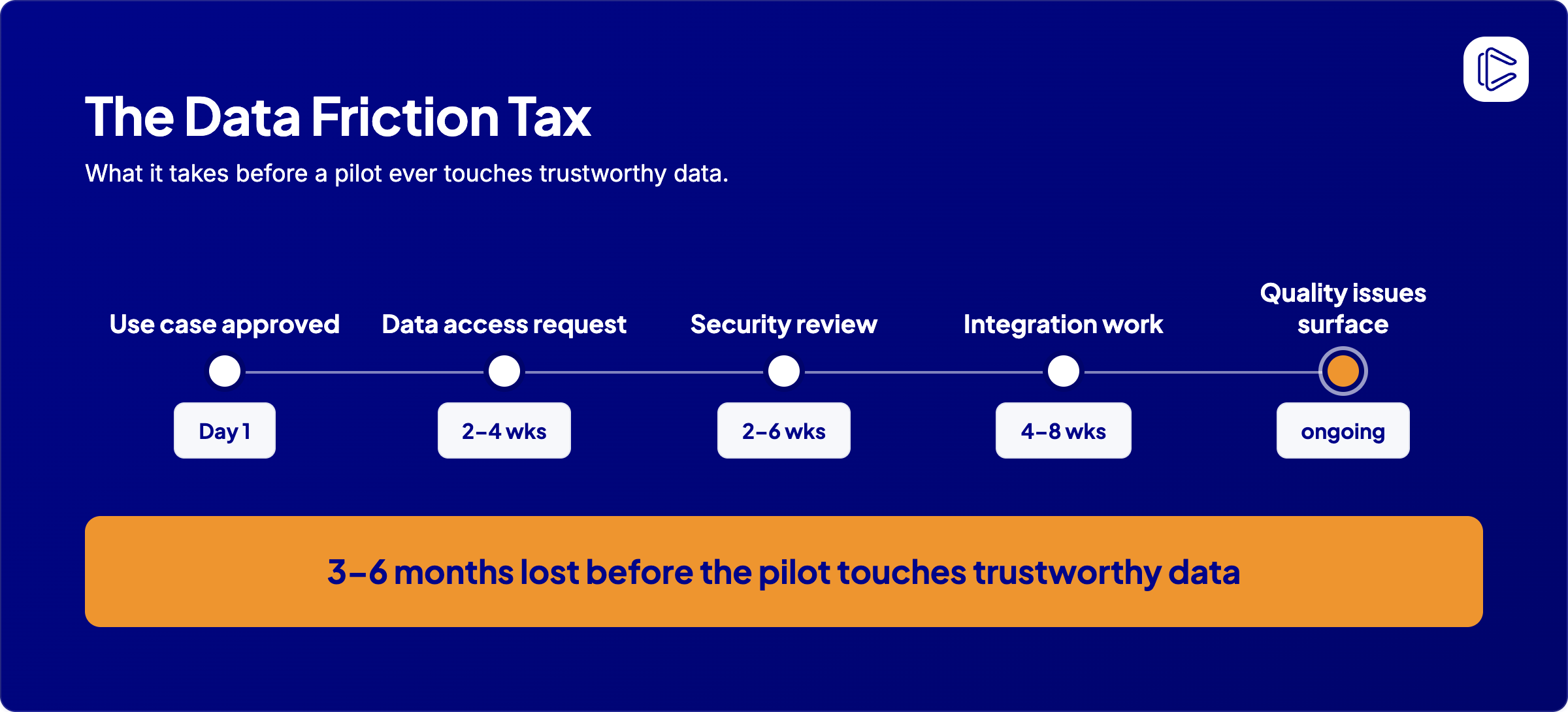
Most enterprises built their data for dashboards: clean enough for a human reading a monthly report. Production AI needs data that's semantic, current, permissioned, and reachable at the moment of work. We call what happens next the data friction tax. The use case gets approved on day one. The data access request takes two to four weeks. Security review takes two to six. Integration work takes four to eight. Quality issues surface after all of that. Three to six months are gone, and most of the executive sponsorship with them, before the pilot ever touches trustworthy data.
Gartner found that 63% of organizations either lack or are unsure they have the right data management practices for AI, and predicts that through 2026, organizations will abandon 60% of AI projects unsupported by AI-ready data. In our experience, most of what gets called an AI-readiness problem is an old data problem AI just made visible. It stays invisible until you map the workflow and see exactly which data the agent needs, at which moment.
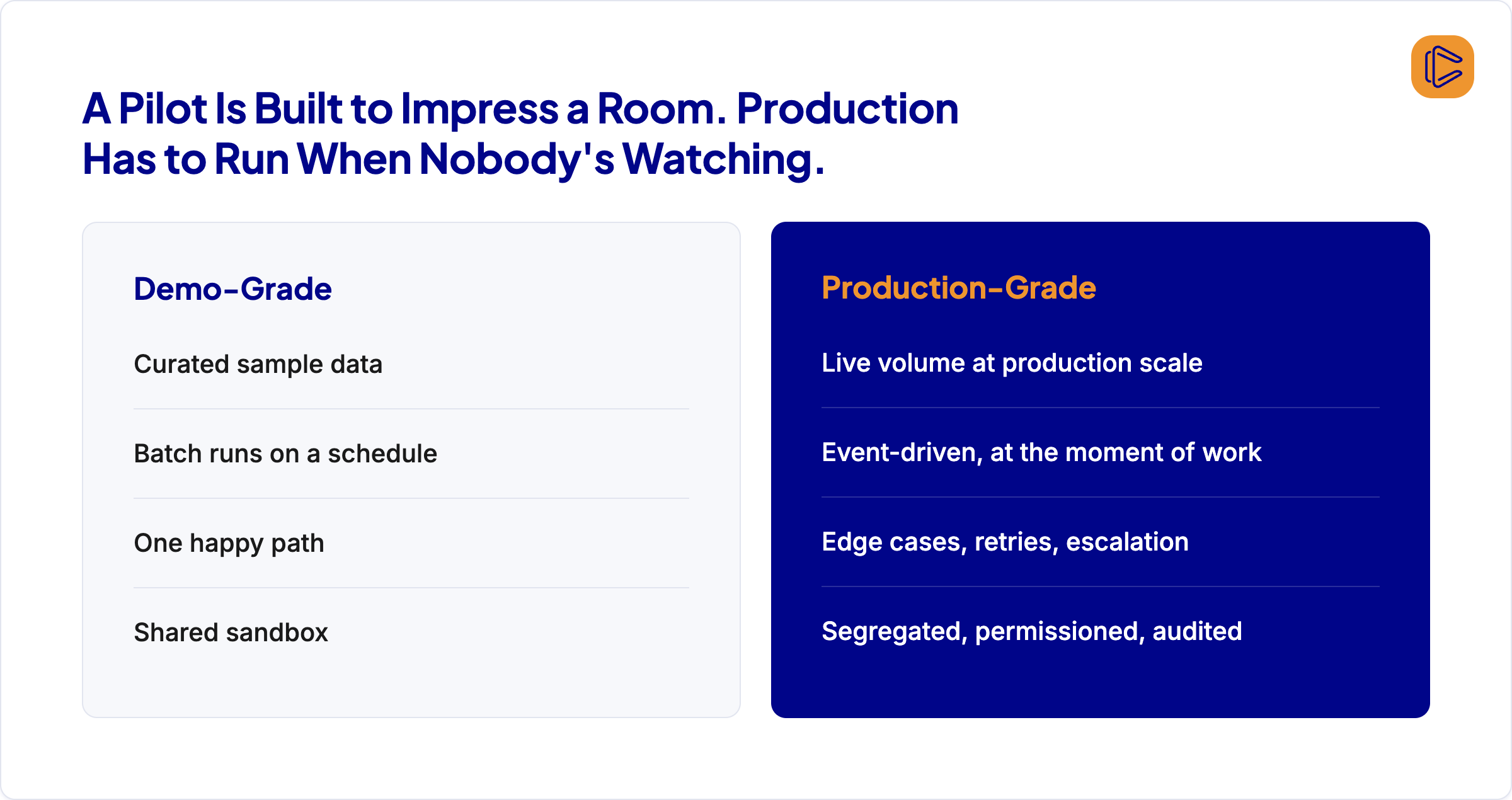
It demos beautifully and breaks in its first week of live use. A pilot is built to impress a room. Production has to run when nobody's watching.
A healthcare SaaS team we worked with started with a sensible pilot architecture: batch processing on a schedule. It demoed well. Then production arrived with requirements the pilot never had to meet. Patient communications couldn't wait for the next batch window. Live volume created queuing problems. Customer data needed stricter segregation. The team rebuilt toward an event-driven architecture mid-flight, at mid-flight prices.
An agtech robotics company came to us with the same pattern from the other direction: proof-of-concept code that had impressed investors and then crashed on production data volumes. After the rebuild on a production-grade IoT platform, the system caught crop stress weeks before the human eye could see it. The vision was the easy part. Making it survive contact with production data was the work. Demo-grade and production-grade are different products, and the production requirements only surface when you map the workflow the system has to live inside.
The pilot proves out, then dies in security and compliance review at the rollout gate. By that point the review is adversarial: the system already exists, and every control has to be retrofitted into an architecture that never planned for it.
AI governance is the answer to three questions. Who is allowed to use this AI system, with what data, and what happens when it gets something wrong? Most pilots reach the rollout gate unable to answer any of the three, because governance was treated as a review step instead of a design input. A redesigned workflow answers them as a byproduct: the judgment points tell you where approvals live, the data map tells you what's permissioned, and the exception path tells you what happens on a miss.
Skip early governance and you get shadow AI instead: employees running their own ChatGPT with company data, the least governed outcome available.
Budget season arrives and the pilot has a story instead of a number. Stories lose to numbers.
No baseline, no before, no after. This is the purest symptom of the root cause: if you never redesigned a specific workflow, there was never a metric to baseline. Redesign one and the measure names itself — cycle time, error rate, cost per transaction, hours returned.
The clause to insist on in a first AI contract: a specific production date, a specific business metric that has to move by that date, and a defined consequence if it doesn't. Most first AI contracts measure effort. They should measure outcomes.
Licenses went out company-wide. Usage spiked for a week, then flatlined.
At one heavy-equipment manufacturer, leadership had already rolled out AI tooling when we arrived. Adoption had split down the middle: engineering used it daily, while the business and operations teams that represented most of the value barely touched it. The license count was never the constraint. Nobody had redesigned the workflows those licenses were supposed to change, so there was no new way of working to adopt.
A working AI system with 8% adoption is a $200,000 line item on your P&L that doesn't move the business. Plan 30 to 40 percent of build cost for adoption, with at minimum one champion per fifty users, and treat enablement as its own workstream. AI skills deprecate every three to four months, so a once-a-year training rollout flatlines almost as fast as it ships. Scaling the tool is procurement. Scaling the skill is adoption.
Count how many of these symptoms you recognize. One or two is normal. Three or more is the pattern, and the pattern has one root cause: a tool was added to a process, and the workflow was never redesigned around it.
Before your next pilot review, put six questions in front of the room:
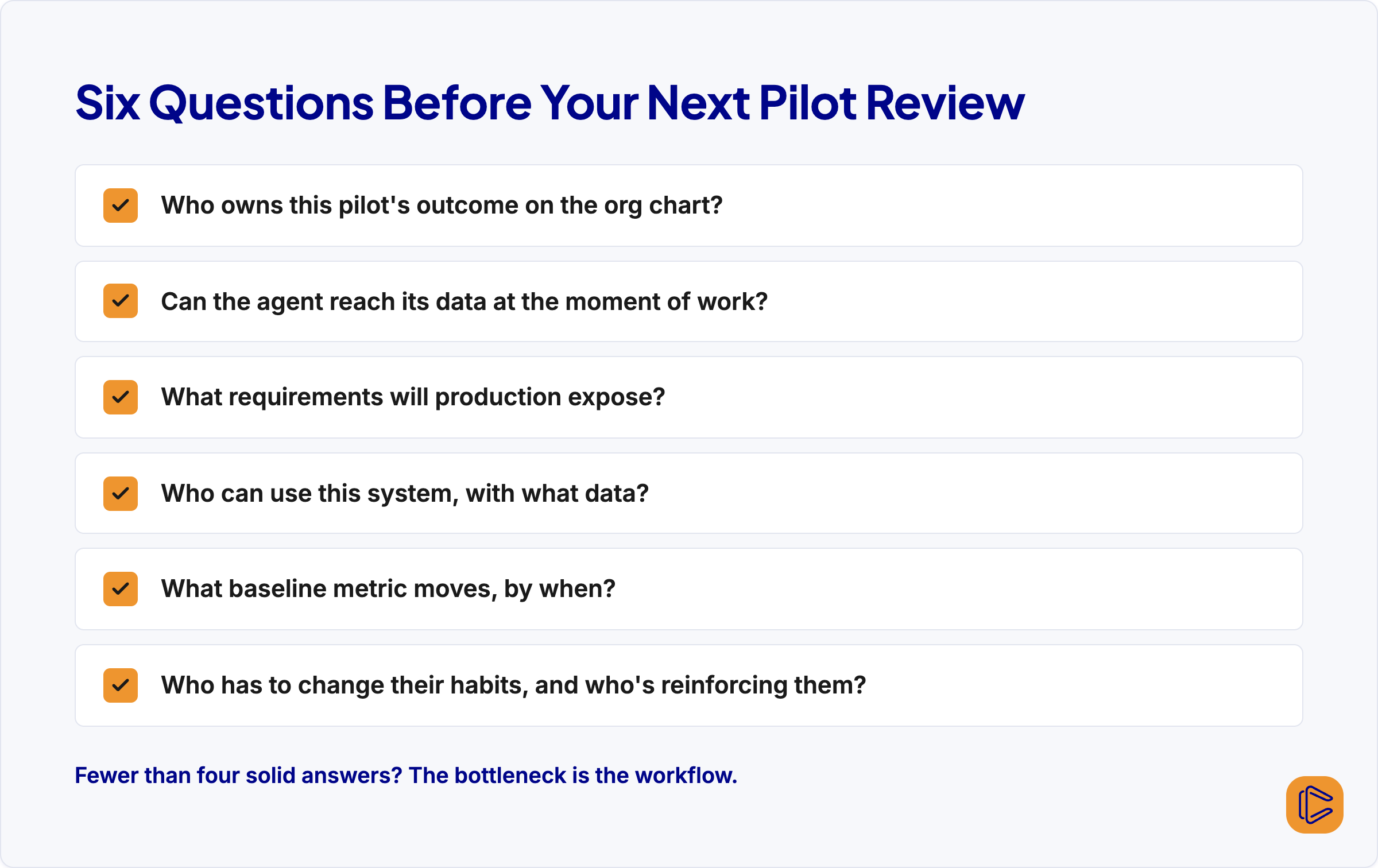
If the room can't answer four of the six with specifics, the bottleneck is the workflow. The fix is a workflow reset: identify the decision, map the judgment points, define the production requirements, and baseline the metric. If your pilot is already stalled, we've written the step-by-step: How to Rescue a Stalled AI Pilot.
Most AI pilots fail because the organization added AI to an existing process instead of redesigning the workflow around it. MIT's 2025 NANDA research found 95% of enterprise generative AI pilots deliver no measurable return, and the failures trace to workflow integration, not model quality.
Assign a business owner to the outcome, confirm the data is reachable at the moment of work, design governance in from day one, define production requirements like latency and volume up front, and baseline one workflow metric so ROI is measured instead of assumed.
Nobody redesigns the workflow. Dropping AI into an old process produces a localized bump and no structural change. Map the workflow's judgment points, give the agent the assembly and routing work, and move humans to setting parameters up front and reviewing exceptions at the end.


Eric Carr : May 28, 2026, 4:06:13 PM
You funded an AI pilot. Your team shipped a proof-of-concept. Six months later, it still isn't in production — and the budget conversation for next...

Eric Carr : Apr 14, 2026, 2:02:00 PM
In our previous blog on the AI agent transition, we looked at where this shift stands, the debate it's generating, and why the historical pattern...

Eric Carr : Apr 8, 2026, 4:45:31 PM
Two years ago, most teams were using AI to speed up tasks they already knew how to do. Autocompleting code. Drafting emails. Summarizing documents....